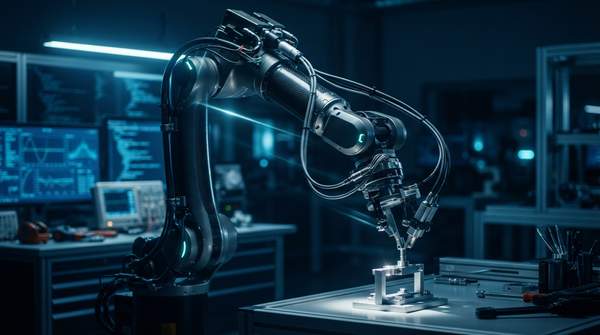
A single Kawasaki CP110L palletizing robot can now process over 2,200 cartons per hour, setting a new benchmark for industrial throughput. The processing of over 2,200 cartons per hour marks a significant advancement in industrial automation, pushing the boundaries of what specialized robots can achieve in high-volume, repetitive tasks.
Industrial robots are achieving unprecedented levels of speed and payload capacity, but the strategic planning for seamless human-robot collaboration and workforce adaptation lags behind. The disparity between robot capabilities and strategic planning creates a critical challenge for manufacturing sectors aiming for holistic automation.
Companies that fail to strategically integrate these powerful new automation tools, including the forthcoming Kawasaki Robotics Dexterous Physical AI Robot Platform by 2026, risk significant competitive disadvantage and operational inefficiencies in the coming years.
New Benchmarks in Palletizing and Picking
The Kawasaki CP110L palletizing robot processes over 2,200 cartons per hour, according to Kawasaki Robotics. In contrast, the Kawasaki RKS robot targets a picking rate of 10-15 picks per minute in pilot operation, according to Kawasaki Robotics. This significant disparity in throughput between dedicated high-speed automation and more nuanced collaborative tasks reveals that technological advancements are not uniform across all robotic applications. Companies prioritizing raw throughput with solutions like Kawasaki's CP110L set new efficiency benchmarks, but risk creating bottlenecks elsewhere if their entire logistics chain is not equally optimized.
The Evolution of Collaborative Robotics
Kawasaki plans to introduce heavy-payload CL cobots by 2026, according to Kawasaki Robotics. Kawasaki's plan to introduce heavy-payload CL cobots by 2026 expands robotic utility into heavier-duty applications. The staggered rollout of advanced cobots like the CL series by 2026 suggests that while hardware evolves rapidly, integrating high-payload collaborative robots into existing human workflows remains a significant, multi-year challenge for manufacturers.