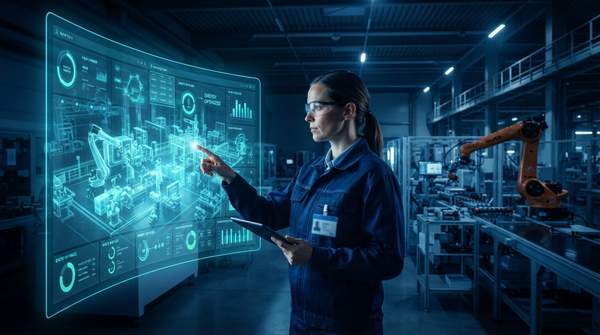
A digital twin improves sustainability in manufacturing not through any single component, but through a closed circuit: sensors on physical equipment feed data into a continuously updated virtual replica, analytics engines test that data against optimization goals, and the resulting commands flow back to the real production line. Research on industrial digital twins describes this bidirectional exchange as the mechanism that enables energy-saving decision-making and sustainable predictive maintenance. Understanding that circuit—and where each layer sits within it—is what turns an abstract technology concept into an implementable plan.
Understanding the Digital Twin Architecture for Sustainable Manufacturing
A digital twin is defined by the connection it maintains between a physical system and its virtual model. Writing for Simio, Matilda Adolphsen notes that fully interactive digital twins established bidirectional communication between physical processes and their digital replicas, creating what she describes as "powerful feedback loops that enhanced optimization, labor utilization, predictive maintenance, and decision-making processes." Before recent advances in computing power and the integration of information technology (IT) with operations technology (OT), digital twins primarily served as one-way simulation tools rather than interactive systems.
That shift matters for sustainability specifically. A review of AI-enabled digital twin research published in Sustainability observes that traditional methods often struggle with nonlinear dynamics, operational uncertainty, or competing objectives, especially when sustainability must be integrated into real-time decision-making rather than assessed after the fact. In contrast, digital twins maintain a real-time connection between physical manufacturing systems and their digital representations, enabling monitoring, prediction, and control. The architecture is therefore not incidental to the sustainability outcome; it is what makes real-time environmental optimization possible at all.
Digital Twin Architecture for Sustainable Manufacturing
The framework below traces how operational data is captured, analyzed against sustainability targets in a virtual environment, and converted into optimized commands fed back to the physical asset. A paper presented through IEEE on industrial digital twin architecture proposes exactly this integrated view: unified control of networking and industrial equipment that can "enable energy-saving decision-making policies and support sustainable predictive maintenance in manufacturing."
| Layer | Function | Data flow | Sustainability impact |
|---|---|---|---|
| Physical Asset Layer | Real-world manufacturing equipment and processes that generate operational data | Origin of all sensed data; prerequisite for the twin | Source of the ground-truth measurements the model optimizes |
| Data Transmission Layer | Integrates IT and OT systems to collect and transmit data from physical assets | Carries sensor readings upward to the virtual model | Enables the real-time monitoring sustainability decisions depend on |
| Virtual Model Layer | Digital replica of the asset, continuously updated with live data | Receives physical data; mirrors current asset state | Provides the environment where green scenarios are tested risk-free |
| Analytics & Simulation Layer | Combines physics-based and data-driven models to analyze, predict, and simulate | Reads the virtual model; runs "what-if" optimization | Identifies energy and resource savings before physical changes are made |
| Control & Action Layer | Translates analytical insights into decisions or automated controls | Returns commands to the physical system, closing the loop | Adjusts machine parameters and schedules maintenance to cut waste |
The two sustainability applications at the end of that loop—energy optimization and predictive maintenance—are where the architecture pays off. The digital twin market in manufacturing is projected to reach $73 billion by 2030, growing at 61% annually, according to the Sustainability review, though early implementations focused mainly on high-fidelity simulation for process understanding rather than sustainability.
Enabling Energy Efficiency Optimization
Because the transmission layer keeps live operational data flowing into the virtual model, a digital twin can analyze energy consumption as it happens rather than in monthly reports. The IEEE architecture research frames this capability as energy-saving decision-making policy: with IT and OT ecosystems integrated, an asset's power draw, operating state, and process parameters are visible together, so analyses can identify where energy is being consumed and simulate less intensive alternatives.
AI-enabled digital twins are increasingly promoted as core enablers of energy efficiency, carbon reduction, and sustainable system operation, according to the Sustainability review, which notes that across manufacturing, buildings, smart cities, and energy systems the prevailing narrative assumes more data, learning, and automation translate directly into improved sustainability outcomes. The review adds a critical caveat, however: current implementations remain "physics-heavy, uncertainty-light, and sustainability-naïve by design," and it also flags the environmental cost of the intelligence itself as an open trade-off. HSO's expert commentary on smart factories describes the practical mechanism on the plant side: twins enable simulation of different scenarios to optimize production processes, including "what-if" analysis of potential production line changes before they are made physically.
Driving Predictive Maintenance for Waste Reduction
Predictive maintenance is where the architecture converts data into avoided waste. OXMaint identifies it as "consistently cited as the highest-impact application of digital twin technology in manufacturing," with process modeling that predicts failures before they happen. The mechanism is architectural: because the virtual model is continuously synchronized with the physical asset, the analytics layer can detect degradation patterns as they emerge and trigger intervention before failure.
Research on digital twins in intelligent manufacturing, published through SCIEPUBLISH, shows what this looks like in practice for CNC milling machines: predictive analysis of mechanical process systems through algorithmic models enables fault diagnosis, error suppression, life prediction, and parameter optimization, which improves the operation mode and reduces the probability of sudden failure. The same research emphasizes that intelligent decision-making significantly contributes to the resource utilization of machining processes. The waste-reduction logic is direct—an anticipated failure can be serviced during planned downtime rather than scrapping in-process material, and life prediction extends component use instead of replacing parts on fixed schedules.
The Continuous Feedback Loop for Adaptive Sustainability
What distinguishes a digital twin from a static simulation model is that the loop never closes permanently. Each cycle—sense, mirror, analyze, act—updates the virtual model with fresh physical data, so the twin's accuracy compounds over time. When energy-saving parameters are applied to the physical asset, their real effect flows back through the transmission layer and becomes new evidence for the next optimization pass.
This adaptivity is what allows sustainability targets to evolve with production reality rather than trailing it. The hybrid AI-physics architectures highlighted in the Sustainability review reflect this design tension: purely data-driven models gain predictive performance, while physics-based models preserve physical consistency and explainability—both necessary when a model's output drives real changes to energy use and equipment schedules. A twin that only reports, or only simulates offline, captures a fraction of this value.
Implementing Digital Twins for Sustainable Manufacturing
Manufacturers should prioritize the integration of IT and OT systems to establish a robust digital twin architecture capable of real-time data collection and analysis for sustainability initiatives. The IEEE research is explicit that how to properly integrate these ecosystems "has to be further investigated," so treat integration as the engineering problem it is rather than a plug-in feature.
Successful implementation will be indicated by the establishment of a continuous, bidirectional data flow between physical manufacturing assets and their virtual models, enabling adaptive optimization for energy and waste reduction. That flow—measurable in the synchronization between asset state and model state—is the observable condition that separates a functioning sustainability twin from an expensive visualization, and it is the milestone any implementation plan should be built around.