Carbon capture and utilization (CCU) is often described as a single strategy, but its two leading pathways run on fundamentally different logic. Turning point-source CO2 into building materials locks carbon away for decades or longer. Turning CO2 into fuels recycles it, releasing it back to the atmosphere on combustion. One is a storage play; the other is a fossil-substitution play — and each depends on a different set of policy levers to survive economically.
Understanding Carbon Capture Utilization (CCU) Pathways
CCU means converting captured CO2 into value-added products rather than, or alongside, storing it underground. An IEA Greenhouse Gas R&D Programme comparison of utilization pathways notes that early projects captured CO2 from the high-concentration emissions of natural gas processing and fertilizer plants, and are expanding into power generation and iron and steel production, while direct air capture — pulling CO2 straight from ambient air — has recently been demonstrated. The same review identifies the main product families as building materials, chemicals, polymers, and synthetic fuels.
Where the carbon comes from matters as much as where it goes. A World Economic Forum summary of a CCU report finds that emerging pathways are concentrated in fuels, chemicals, and building materials — and that fuels alone account for 11.5 Mtpa CO2 of the 15 Mtpa in development by 2030. That skew is why the Forum argues investment diversification beyond fuels will be critical for CCU to reach its full economic and emissions-abatement potential.
Pathway 1: Point-Source CO2 to Building Materials
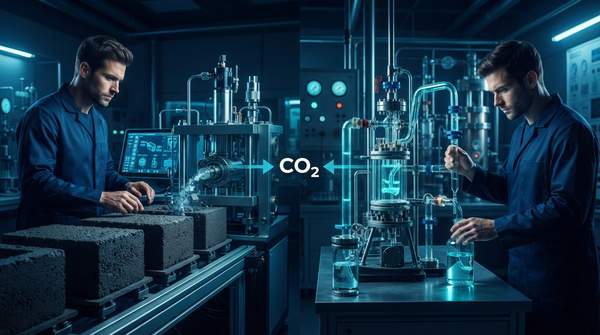
This pathway captures CO2 from industrial flue gases — cement plants are the classic case — and mineralizes it into construction products such as CO2-cured concrete and building aggregates. The industrial source can vary, but it is typically point-source rather than ambient air. Carbonatable materials and the availability of CO2 are the practical constraints an IEAGHG building-materials study highlights alongside process efficiency.
The climate value is durability. Storing captured CO2 in building materials is, in that study's assessment, a more permanent option than is the case for many other CCU pathways, such as fuels or chemicals. Two caveats keep this honest: permanence still depends on the material's longevity and end-of-life management, and any new building material must meet standards the construction industry will actually accept, at a reasonable cost, despite its environmental benefits.
Pathway 2: CO2 Conversion to Fuels
The fuels pathway converts captured CO2 into synthetic products — chiefly e-kerosene and e-methanol — that substitute for fossil fuels and are designed to be compatible with existing infrastructure. The CO2 feedstock can come from industrial flue gas or direct air capture, and the source choice significantly affects the fuel's lifecycle emissions. Conversion also typically requires hydrogen, which drives both cost and the carbon math of the final product.
The crucial distinction is that the CO2 is only temporarily stored. When the fuel is burned, the carbon returns to the atmosphere. The pathway's climate contribution comes from displacing fossil fuel extraction and combustion — reducing net emissions by substitution — not from permanent removal. That is a genuinely different service from mineralization, and confusing the two leads to bad accounting and bad investment.
Comparative Overview of CCU Pathways: Building Materials vs. Fuels
The table below juxtaposes the two pathways across the dimensions that actually determine their viability: where the CO2 comes from, what happens to the carbon, and which economic lever each one leans on.
| Dimension | Point-Source Capture to Building Materials | CO2-to-Fuels |
|---|---|---|
| Pathway example | Capture from industrial flue gases, utilized in construction materials | Conversion of captured CO2 into synthetic fuels such as e-kerosene and e-methanol |
| Typical CO2 source | Point-source industrial emitters, e.g. cement plants (direct capture from processes, not ambient air) | Varies: industrial flue gas or direct air capture; source choice strongly affects lifecycle emissions |
| Product category | CO2-cured concrete and building aggregates, reducing need for conventional materials | E-fuels compatible with existing infrastructure but requiring significant energy input, including hydrogen |
| Carbon lifecycle | Stored long-term in the material — a comparatively permanent form of storage, contingent on durability and end-of-life handling | Recycled: temporarily held in the fuel and re-emitted on combustion; abatement comes from displacing fossil fuels, not removal |
| Key economic driver | Landfill taxes, regulatory incentives, public procurement targets and carbon pricing — without them, CO2-derived aggregates cost roughly four to five times more than conventional ones | Clean fuel mandates and hydrogen economics — EU e-fuel mandates, carbon pricing, and hydrogen subsidies that lower the levelized cost of e-kerosene and e-methanol |
| Potential scale | Large materials market; cement's array of uses offers a significant opportunity, subject to construction-industry standards | Dominates near-term CCU: fuels represent 11.5 of the 15 Mtpa CO2 in development by 2030 |
Read side by side, the table makes the trade-off explicit: building materials buy permanence but need regulatory help to close a four-to-five-fold cost gap, while fuels already dominate the development pipeline but only recycle carbon rather than removing it.
Economic Drivers and Policy Incentives for Building Materials
Why would anyone pay several times the conventional price for aggregate? Because policy can flip the economics. An Oil and Gas Climate Initiative report on CCU finds CO2-derived construction aggregates are four to five times more expensive than conventional ones without landfill tax rates — and landfill taxes matter precisely because they make it more expensive to discard waste streams than to utilize them. That is why the report concludes regulatory incentives, public procurement targets, and carbon pricing will be required to drive wide-scale adoption.
The UK is the live example: the OGCI report notes it already has high landfill taxes that enable the economic viability of construction aggregates, alongside a Net Zero Building Council that could eventually set standards for low-carbon building materials. In the US, the Infrastructure Investment and Jobs Act provides grants for states and municipalities to procure building materials made with captured CO2, such as concrete and aggregates, according to Resources for the Future. Europe adds a pull of its own: emissions converted to stable materials through mineralization are already exempt from the ETS.
Economic Drivers and Policy Incentives for CO2-to-Fuels
Fuels run on mandates and hydrogen. The OGCI report lists the EU's e-fuel mandates under FuelEU and Fit for 55, the ETS carbon price, and the updated RED III requiring renewable fuels of non-biological origin by 2034, plus binding sector targets. In the US, the Inflation Reduction Act's hydrogen credit indirectly enables several CCU pathways by reducing the levelized cost of the hydrogen required to produce e-kerosene and e-methanol, and the stackable 45Z tax credit incentivizes low-carbon fuels. The UK plans a sustainable aviation fuel mandate from 2025.
These are demand-side engines rather than cost fixes. A C2ES analysis of carbon utilization argues that expanded low-carbon fuel standard policies, carbon-intensity disclosure, better lifecycle analysis, incentives for carbon-based products, and targeted procurement are all critical tools to scale the field. For e-fuels specifically, mandates create the market; cheap low-carbon hydrogen determines whether producers can serve it.
Navigating CCU Investments: Policy as the Primary Driver
My read of the evidence is blunt: neither pathway stands on its own economics today. Decision-makers should prioritize understanding the specific policy and economic incentives in their region when evaluating CCU investments, because those factors — not technology alone — determine viability and scale. The two pathways also answer different questions, so treat them as complements: mineralization for durable storage in a huge materials market, e-fuels for displacing fossil combustion in sectors that cannot easily electrify.
The measurable indicator to watch is the introduction and strengthening of policies such as landfill taxes, carbon pricing mechanisms, and clean fuel mandates, which will directly signal market readiness and support for CCU products. The dated milestones are concrete: the UK's sustainable aviation fuel mandate from 2025, and the EU's RFNBO requirement taking effect by 2034. When those levers tighten, the cost gaps documented here — the four-to-five-fold premium on aggregates, the hydrogen intensity of e-fuels — are the numbers that policy will have to close.